Why we let attackers guard the keys
Every secure system on the internet rests on someone's promise that a key hasn't been stolen. Adversarial Security replaces the promise with a number anyone can check.

The promise that keeps breaking
When you load a bank's website or install a signed update, you're trusting a key — a piece of cryptography asserting "this really came from them." You don't verify that yourself. A certificate authority vouches for it.
The trouble is that certificate authorities get breached. In 2011 attackers took the seeds behind RSA's SecurID tokens, undermining two-factor authentication at defense contractors worldwide. The Dutch CA DigiNotar was compromised and used to issue fraudulent Google certificates against Iranian users; it went bankrupt within two months. Symantec mis-issued thousands of certificates and lost its place in Chrome. In 2023 China-based actors stole a Microsoft signing key and forged access tokens for government email. SSLMate keeps a running timeline of these failures, and it is not short.
Each breach shares a shape. Trust was asserted, not measured. When one authority fell, every certificate it ever issued became suspect — and nobody could tell when it went bad. Revocation lists lag compromise by weeks.
The people guarding the keys are paid the least
The whitepaper makes a point most security writing skips. The people who administer sensitive systems are often the lowest-paid staff in the organization. The 2015 OPM breach exposed security-clearance files on 21.5 million people — administered by contractors on modest salaries, guarding data whose loss was measured in billions and in national-security harm.
When a key's value is invisible, organizations rationally underinvest in protecting it. Attach real money to that key and the incentive corrects itself: nobody runs a wallet holding ten million dollars on a default password.
The move: put money on the key
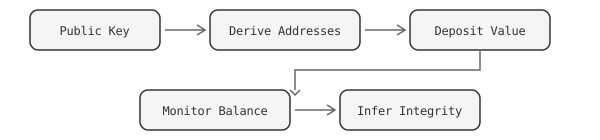
A signing key can mathematically derive wallet addresses across many blockchains, using the hierarchical-deterministic standards BIP-32, BIP-44 and SLIP-10. The same key that signs your data controls those addresses. One key pair, two jobs, no new infrastructure.
So you deposit funds there. The key now carries a public bounty — and Bitcoin and its successors make that balance auditable by anyone, every block, forever.
Why an attacker gives themselves away
If someone steals the private key, the rational move is to drain the funds immediately. Withdrawal is instant, irreversible, and carries no additional risk — they already have the key. If several attackers hold the same stolen key, they race each other, which only makes it faster.
So the contrapositive is the security property:

Recruiting your enemies
Here is the inversion the name points at. Because derived addresses are permissionless, anyone can raise the stakes on a key they need to trust — no permission required. A hospital depending on a device vendor's signing key can fund that key's addresses directly.
They can go further and publish a bounty: here is the key, here is what it protects, here is when more money arrives. That invitation reaches the people most able to break it — hacker collectives, nation-state operators, organized crime. If they cannot drain it, the key's integrity has been demonstrated against the most capable adversaries on Earth.
The economics underneath
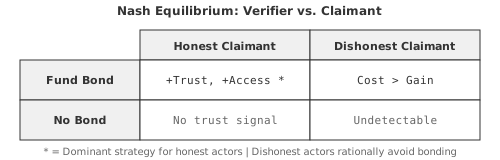
The bond works as a costly signal, in the sense biologist Amotz Zahavi gave the term with the handicap principle: the expense is exactly what makes it believable. It is also skin in the game in Nassim Taleb's sense — the claimant carries real downside for their own claim.
Requiring funds across several independent chains raises the bar again: a forger must hold real assets on each one, with different address formats, fees and liquidity. Honest actors with long horizons fund the bond because trust pays back. Hit-and-run actors find it too expensive. The two populations separate.
Within an organization the same logic runs sideways. Shared reputation means one person's compromised key lowers everyone's score, which is a live incentive to police each other — the peer enforcement Elinor Ostrom documented in Governing the Commons.
It does not replace PKI. It anchors it.
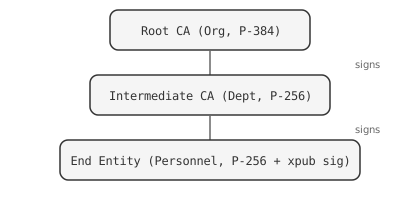
An X.509 certificate can be bound to a blockchain identity by signing the certificate's public key with the crypto private key and embedding that signature as a certificate extension. Anyone can then walk the chain: certificate → signature → crypto public key → derived addresses → observable balance.
That binding prevents identity splitting, where an adversary presents a legitimate certificate and a legitimate wallet as belonging to different entities, playing separate trust games with each.
Why the systems we have today don't work
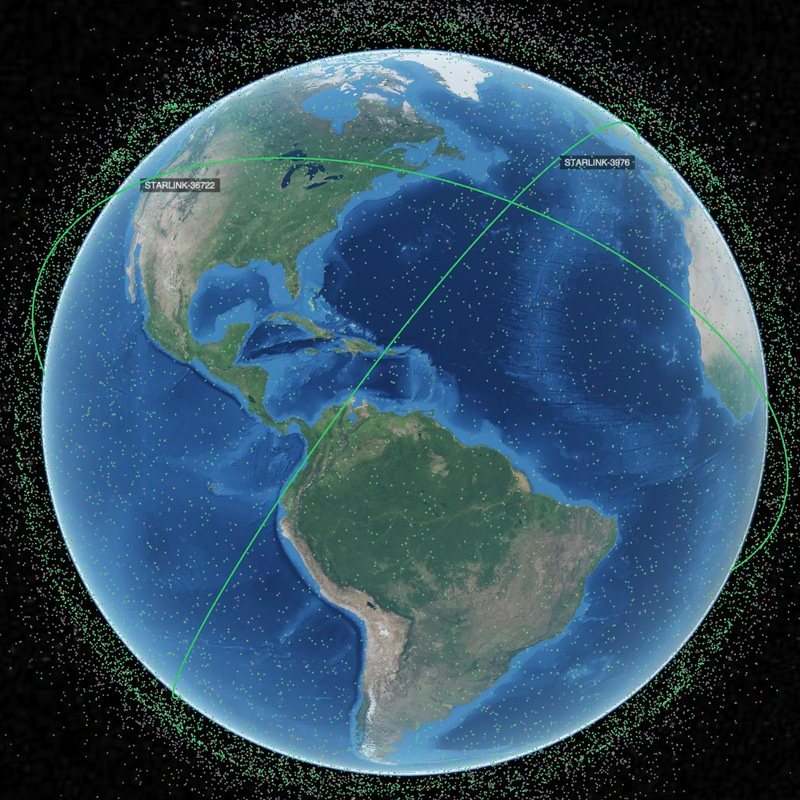
None of this would matter if orbital data already moved cleanly between the people who need it. It doesn't. The operators, agencies and companies tracking objects in orbit are each sitting on their own island, and the water between them is deliberately hard to cross.
Nobody agrees on a format. Government catalogs, commercial trackers and academic sensors all publish different shapes of the same fact. Even where standards exist, proprietary systems wrap them in their own containers, and each vendor's "export" is a dialect. There is a CCSDS standard for most of this; adoption is another matter.
Interoperability is broken in practice, not in theory. Two systems can both claim standards compliance and still fail to exchange a usable conjunction message, because the semantics — reference frames, time systems, covariance conventions — drift apart even when the syntax lines up.
Just moving the data is a project. Pulling a full public feed is not a query, it's a pipeline. The starlink_downloader tool exists precisely because collecting one operator's ephemerides means scraping, paginating, rate-limit dodging and retrying — for data that is nominally public.
Everything needs converting and cleaning. By the time a record reaches an analyst it has been reformatted several times, and every hop is a chance to silently mangle an epoch, drop a covariance or transpose a frame. The cleaning work is invisible, unbudgeted and repeated independently by everyone.
There are no timeliness guarantees. Nothing tells you whether the state vector you just fetched is four minutes or four days old, whether a newer one exists, or whether the publisher is still alive. For collision avoidance, a stale answer and a wrong answer are the same answer.
And there is no trust between providers. This is the hard one. A commercial operator will not hand its precise ephemerides to a competitor, and no government will accept a rival's numbers on faith. Absent a way to verify who published something and whether it was altered, the rational move is to share less, later, and coarser than you could — which is why the network supports encrypted, paid and selectively-disclosed data as first-class options rather than assuming everything is public.
Every one of those failures is a trust failure wearing a technical costume. You cannot fix them with another file format. You need a way for a stranger to prove, cheaply and continuously, that their key is intact and their data is theirs.
What this has to do with $SPACE
The Space Data Network is built on this model. Its nodes, signed data products and identities rest on keys whose integrity is evidenced by visible on-chain value rather than by a certificate someone swore was fine.
$SPACE runs on that layer. It is deliberately not the network's token — the protocol has no native currency and requires none. $SPACE is the first token to use these rails, and the rule is strict: a trust relationship only exists once value has moved. You cannot vouch for a key for free. Watch it on the live trust graph, where every edge is a settled transfer and every balance is an argument. Anyone can run another.
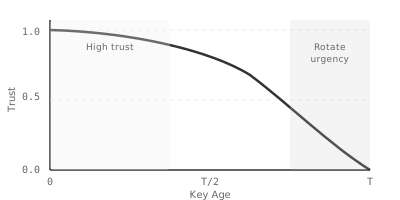
The full paper carries the formal treatment — Nash equilibria, separating equilibria, the threat model, X.509 binding and key-rotation decay. Read it on GitHub →
