$SPACE

Trust, priced in real time.
The trust layer for New Space — a token running on the open protocol that secures the Space Data Network, on Solana.

USD / $SPACE
Market Cap
Liquidity
Contract Ge5rnW2w6EzSh3EkQWxH76P8LEjEJE7qe7entq9pLQ3F

The problem

Trust and data sharing in orbit are broken — and the sky is filling up exponentially.

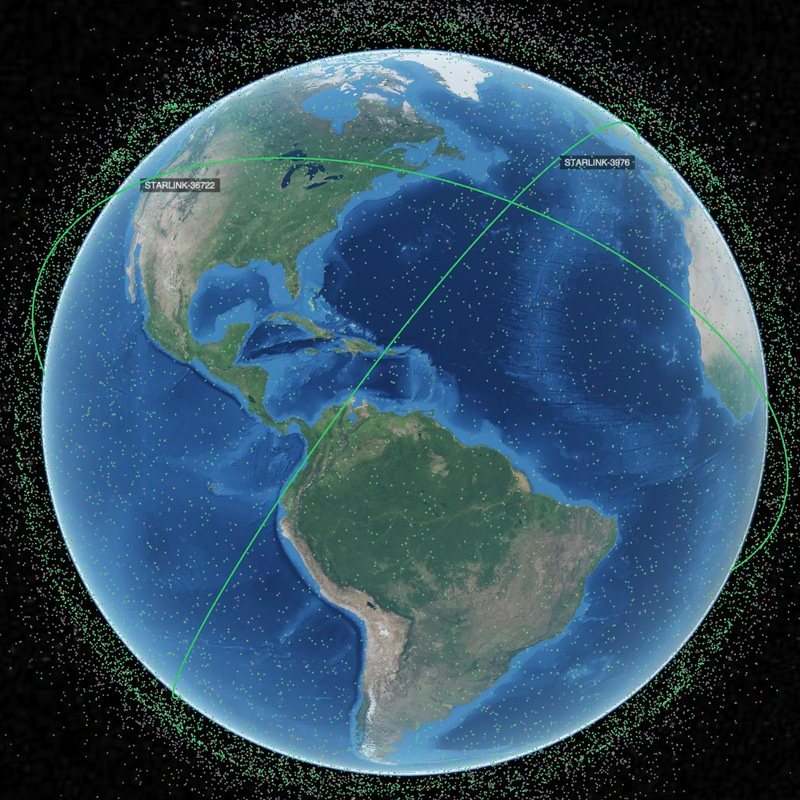
We are adding objects to Earth orbit faster than we are adding any way to safely coordinate them. The tracking works. The sharing doesn't — because no one can verify anyone else. We need data transmission and trust that scale with the growth of space.

100K 75K 50K 25K 0 projected → 202020232025 20282030 total tracked active satellites

Sources: ESA Space Debris Office, Space-Track.org, and operator constellation filings.

~50,000conjunction warnings issued every day
~30,000tracked objects in orbit today
100+avoidance maneuvers every week
100,000+satellites filed for by 2030

Sharing is broken

Every provider speaks a different dialect. Formats disagree, semantics drift, and moving a public feed is a scraping project rather than a query. Data arrives late, converted, and stripped of the context that made it safe to use.

Why the systems we have today fail →

Trust is broken

No operator hands precise ephemerides to a competitor, and no government takes a rival's numbers on faith. Without a way to prove who published what — and that it wasn't altered — the rational move is always to share less, later, and coarser.

How Adversarial Security fixes it →

The clock is the constraint

In 2009 Iridium 33 hit Cosmos 2251 at 11.7 km/s with no warning to either operator, adding 2,000+ trackable fragments. Every one of those is still a hazard. A stale answer and a wrong answer are the same answer.

What the Space Data Network does →

Tracking is not the bottleneck. Verifiable exchange is. That is what the Space Data Network is built for, and $SPACE is the economic layer that makes its trust measurable — you can watch it work on the live trust graph.

The Token

$SPACE is the personal token of tjkoury.sol, launched on ansem.io and trading on PumpSwap (Solana).

Price (USD)
Market Cap
Liquidity
24h Volume
24h Buys / Sells
24h Change

Token details

NameSPACEDATANETWORK
Symbol$SPACE
ChainSolana
DexPumpSwap
Pair$SPACE / SOL
Ownertjkoury.sol (@tjkoury)
Mint addressGe5rnW2w6EzSh3EkQWxH76P8LEjEJE7qe7entq9pLQ3F

What is $SPACE?

$SPACE is the personal token of tjkoury.sol — the builder behind the Space Data Network, a decentralized peer-to-peer network for global space situational awareness (SSA), and the author of the Adversarial Security whitepaper on game-theoretic key integrity.

It isn't a meme looking for a use case. It's a use case with a token. $SPACE puts a measurable, on-chain price on the trust that holds the Space Data Network together — turning the network's own economic security model into a tradeable asset. Holding $SPACE is, in effect, backing the infrastructure the network runs on.

Earth's orbit is getting crowded. Decades of launches have left tens of thousands of tracked objects — and far more untracked debris — circling the planet. The 2009 collision between Iridium 33 and Cosmos 2251 at 11.7 km/s created the largest accidental debris cloud in history, and today operators face ~50,000 conjunction warnings per day. The Space Data Network exists so that the people who need to share orbital data can do it openly, securely, and without depending on any single government or company.

$SPACE is how that ecosystem coordinates and rewards participation — and how tjkoury.sol puts real skin in the game for the work behind it.

Who is the builder?

$SPACE comes from someone who has spent two decades inside the systems it's trying to fix.

tjkoury.sol

Anthony “TJ” Koury III

Space Systems Engineer & Software Architect
CEO, DigitalArsenal.io

Twenty-plus years in space systems engineering, software architecture and geospatial infrastructure — starting in uniform and ending up building the open protocols this token secures. Full history on tjkoury.com.

2001–2007
United States Air Force

Commissioned out of the US Air Force Academy (B.S., 2001). Finished as Chief of Ground Systems Engineering, 3rd Space Operations Squadron, Colorado Springs.

2007–2012
Scitor Corporation

DevOps lead and scrum master for Space-Track.org under JFCC SPACE/J3 — the authoritative public catalog of objects in orbit, with 90M+ records and 30,000+ user accounts.

2012–2014
Analytical Graphics, Inc. (AGI)

Senior systems engineer on STK-based tooling and the SSA Software Suite, including early CesiumJS orbit visualization.

2014–present
Lyteworx Automation Systems

Chief Engineer, Space Systems Division — work spanning national geospatial and defense space programs.

2019–present
DigitalArsenal.io, Inc. — CEO

Building the stack behind $SPACE: the Space Data Network, SpaceAware, OrbPro, and the open Space Data Standards.

Open source

Most of the work is public on github.com/DigitalArsenal.

The through-line: orbital data should be open, verifiable and not gated by any single government or vendor. Adversarial Security is the trust model for that, and $SPACE is its economic expression.

The idea behind $SPACE

Why we let attackers guard the keys

Every secure system on the internet rests on someone's promise that a key hasn't been stolen. Adversarial Security replaces the promise with a number anyone can check.

Adversarial Security shield
The whitepaper's mark. Security not despite adversaries, but because of them.

The promise that keeps breaking

When you load a bank's website or install a signed update, you're trusting a key — a piece of cryptography asserting "this really came from them." You don't verify that yourself. A certificate authority vouches for it.

The trouble is that certificate authorities get breached. In 2011 attackers took the seeds behind RSA's SecurID tokens, undermining two-factor authentication at defense contractors worldwide. The Dutch CA DigiNotar was compromised and used to issue fraudulent Google certificates against Iranian users; it went bankrupt within two months. Symantec mis-issued thousands of certificates and lost its place in Chrome. In 2023 China-based actors stole a Microsoft signing key and forged access tokens for government email. SSLMate keeps a running timeline of these failures, and it is not short.

Each breach shares a shape. Trust was asserted, not measured. When one authority fell, every certificate it ever issued became suspect — and nobody could tell when it went bad. Revocation lists lag compromise by weeks.

The people guarding the keys are paid the least

The whitepaper makes a point most security writing skips. The people who administer sensitive systems are often the lowest-paid staff in the organization. The 2015 OPM breach exposed security-clearance files on 21.5 million people — administered by contractors on modest salaries, guarding data whose loss was measured in billions and in national-security harm.

When a key's value is invisible, organizations rationally underinvest in protecting it. Attach real money to that key and the incentive corrects itself: nobody runs a wallet holding ten million dollars on a default password.
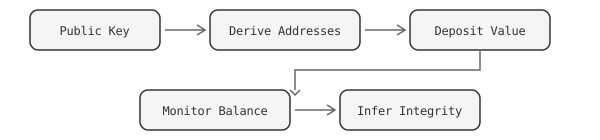
Protocol flow: public key, derive addresses, deposit value, monitor balance, infer integrity
The whole protocol: derive addresses from the key, fund them, watch the balance.

The move: put money on the key

A signing key can mathematically derive wallet addresses across many blockchains, using the hierarchical-deterministic standards BIP-32, BIP-44 and SLIP-10. The same key that signs your data controls those addresses. One key pair, two jobs, no new infrastructure.

So you deposit funds there. The key now carries a public bounty — and Bitcoin and its successors make that balance auditable by anyone, every block, forever.

Why an attacker gives themselves away

If someone steals the private key, the rational move is to drain the funds immediately. Withdrawal is instant, irreversible, and carries no additional risk — they already have the key. If several attackers hold the same stolen key, they race each other, which only makes it faster.

So the contrapositive is the security property:

1
The money is still there → the key is intact. Public proof, refreshed every block.
2
The money is gone → the key was compromised, and you knew the moment it happened.
3
How long it has sat untouched → how long the key has provably been safe. Certificates cannot give you that axis.
Four pillars: key derivation, value as signal, rational actors, real-time proof
Four pillars: derivation, value as signal, rational actors, real-time verification.

Recruiting your enemies

Here is the inversion the name points at. Because derived addresses are permissionless, anyone can raise the stakes on a key they need to trust — no permission required. A hospital depending on a device vendor's signing key can fund that key's addresses directly.

They can go further and publish a bounty: here is the key, here is what it protects, here is when more money arrives. That invitation reaches the people most able to break it — hacker collectives, nation-state operators, organized crime. If they cannot drain it, the key's integrity has been demonstrated against the most capable adversaries on Earth.

The economics underneath

The bond works as a costly signal, in the sense biologist Amotz Zahavi gave the term with the handicap principle: the expense is exactly what makes it believable. It is also skin in the game in Nassim Taleb's sense — the claimant carries real downside for their own claim.

Requiring funds across several independent chains raises the bar again: a forger must hold real assets on each one, with different address formats, fees and liquidity. Honest actors with long horizons fund the bond because trust pays back. Hit-and-run actors find it too expensive. The two populations separate.
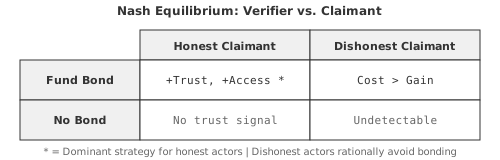
Nash equilibrium payoff matrix
Funding the bond is the dominant strategy for honest actors — and only for them.

Within an organization the same logic runs sideways. Shared reputation means one person's compromised key lowers everyone's score, which is a live incentive to police each other — the peer enforcement Elinor Ostrom documented in Governing the Commons.

It does not replace PKI. It anchors it.

An X.509 certificate can be bound to a blockchain identity by signing the certificate's public key with the crypto private key and embedding that signature as a certificate extension. Anyone can then walk the chain: certificate → signature → crypto public key → derived addresses → observable balance.

That binding prevents identity splitting, where an adversary presents a legitimate certificate and a legitimate wallet as belonging to different entities, playing separate trust games with each.
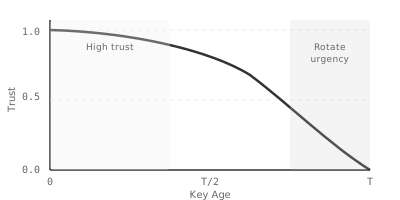
Trust decay curve as keys age
Trust decays as a key ages, creating pressure to rotate before expiry.

Why the systems we have today don't work

None of this would matter if orbital data already moved cleanly between the people who need it. It doesn't. The operators, agencies and companies tracking objects in orbit are each sitting on their own island, and the water between them is deliberately hard to cross.
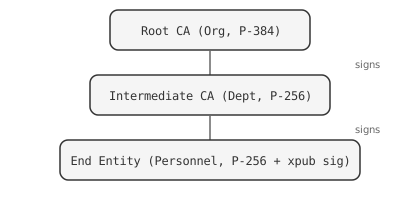
Certificate hierarchy: root CA, intermediate CA, end entity
Delegated authority works inside one organization. Between rivals, it has no root to agree on.

Nobody agrees on a format. Government catalogs, commercial trackers and academic sensors all publish different shapes of the same fact. Even where standards exist, proprietary systems wrap them in their own containers, and each vendor's "export" is a dialect. There is a CCSDS standard for most of this; adoption is another matter.

Interoperability is broken in practice, not in theory. Two systems can both claim standards compliance and still fail to exchange a usable conjunction message, because the semantics — reference frames, time systems, covariance conventions — drift apart even when the syntax lines up.

Just moving the data is a project. Pulling a full public feed is not a query, it's a pipeline. The starlink_downloader tool exists precisely because collecting one operator's ephemerides means scraping, paginating, rate-limit dodging and retrying — for data that is nominally public.

Everything needs converting and cleaning. By the time a record reaches an analyst it has been reformatted several times, and every hop is a chance to silently mangle an epoch, drop a covariance or transpose a frame. The cleaning work is invisible, unbudgeted and repeated independently by everyone.

There are no timeliness guarantees. Nothing tells you whether the state vector you just fetched is four minutes or four days old, whether a newer one exists, or whether the publisher is still alive. For collision avoidance, a stale answer and a wrong answer are the same answer.

And there is no trust between providers. This is the hard one. A commercial operator will not hand its precise ephemerides to a competitor, and no government will accept a rival's numbers on faith. Absent a way to verify who published something and whether it was altered, the rational move is to share less, later, and coarser than you could — which is why the network supports encrypted, paid and selectively-disclosed data as first-class options rather than assuming everything is public.

Every one of those failures is a trust failure wearing a technical costume. You cannot fix them with another file format. You need a way for a stranger to prove, cheaply and continuously, that their key is intact and their data is theirs.

What this has to do with $SPACE

The Space Data Network is built on this model. Its nodes, signed data products and identities rest on keys whose integrity is evidenced by visible on-chain value rather than by a certificate someone swore was fine.

$SPACE is the native expression of that value — the asset participants use to bond, to signal trust in each other, and to put skin in the game across the network. You can watch it happen on the live trust graph, where every transfer is a trust edge and every balance is an argument.

The full paper carries the formal treatment — Nash equilibria, separating equilibria, the threat model, X.509 binding and key-rotation decay. Read it on GitHub →

The Space Data Network

The real-world project $SPACE powers. spacedatanetwork.org →

Built on IPFS & libp2p

Decentralized peer-to-peer data exchange — DHT discovery, GossipSub messaging, and circuit relay so even browsers behind firewalls can connect.

Space Data Standards

CCSDS-compliant schemas (OMM, TLE, TDM, CDM, EPM and more) with zero-copy FlatBuffers serialization — 160+ standardized message types.

End-to-end security

Noise Protocol transport with forward secrecy, AES-256 field-level encryption at rest, and cryptographic identities via Entity Profile Manifests.

Cross-platform

Full nodes on servers, edge relays on embedded devices, or direct browser connections — one stack from cloud to web.

Open-source astrodynamics

SGP4/SDP4 propagators, observation association, orbit determination, and conjunction assessment — in both Go and WebAssembly.

Data marketplace

An opt-in commercial layer for premium data and encrypted WASM modules, while core SSA data exchange stays free and open.

Why this matters now

~50,000conjunction warnings / day
~30,000tracked objects in orbit (2026)
100+avoidance maneuvers / week
100,000+satellites planned by 2030

On Feb 10, 2009, Iridium 33 hit Cosmos 2251 at 11.7 km/s over Siberia — neither operator had warning. With shared infrastructure, that collision could have been avoided with a simple maneuver.

Get $SPACE

  1. Get a Solana wallet. Phantom or Solflare are the easiest — browser extension or mobile app.
  2. Fund it with SOL. Buy SOL on any major exchange and send it to your wallet address.
  3. Swap SOL → $SPACE. Paste the mint address Ge5rnW2w6EzSh3EkQWxH76P8LEjEJE7qe7entq9pLQ3F into a Solana DEX aggregator and swap.
  4. Hold, use, or provide liquidity. $SPACE lives on the open PumpSwap pool.

⚠️ Crypto is volatile and risky. This site is informational, not financial advice. Do your own research, never invest more than you can afford to lose, and verify the contract address before any swap.